
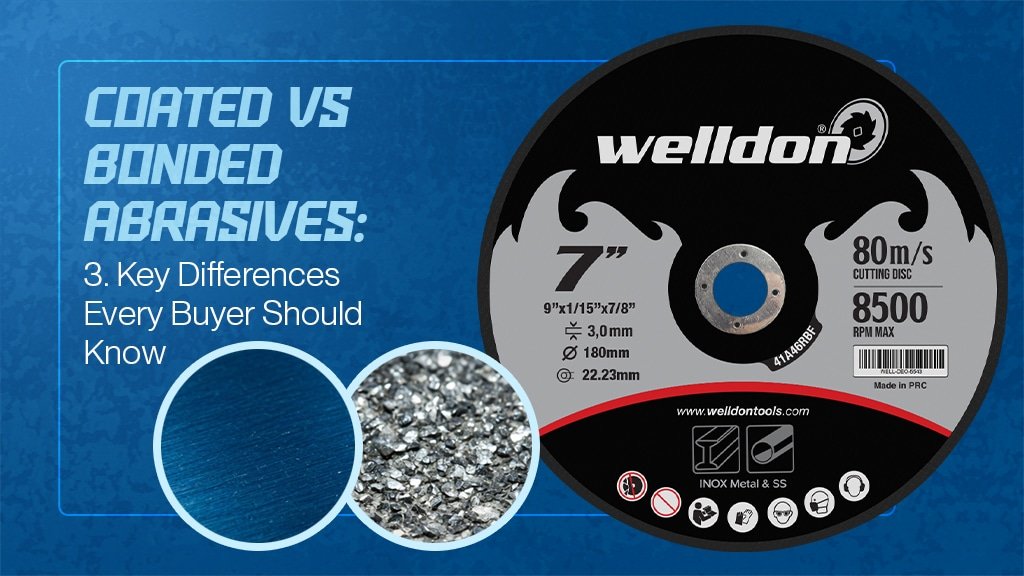
In industrial environments, the right abrasive choice can directly impact productivity, cost efficiency, and product quality. Yet, one of the most common areas of confusion—especially for new buyers and procurement teams—is understanding the difference between coated vs bonded abrasives.
At first glance, both may seem similar. After all, they’re designed to cut, grind, and finish surfaces. But in reality, they serve very different purposes, and choosing the wrong type can lead to poor performance, higher costs, and operational inefficiencies.
This guide breaks down the key differences between coated and bonded abrasives, helping B2B buyers, distributors, and manufacturers make informed decisions.
What Are Coated Abrasives?
Coated abrasives are made by bonding abrasive grains onto a flexible backing material such as paper, cloth, or fiber.
The structure typically includes:
- A backing (paper, cloth, polyester, or fiber)
- Adhesive layers (make coat and size coat)
- Abrasive grains (aluminum oxide, silicon carbide, etc.)
This layered construction makes coated abrasives flexible and versatile, ideal for applications requiring surface finishing and polishing.
Common Examples of Coated Abrasives
- Sandpaper sheets and rolls
- Flap discs
- Sanding discs
- Abrasive belts
These products are widely used in industries where surface quality and finish are critical.
What Are Bonded Abrasives?
Bonded abrasives are manufactured by combining abrasive grains with bonding materials and forming them into solid shapes.
Unlike coated abrasives, they do not rely on a backing. Instead, the abrasive grains are held together by bonding agents such as:
- Resin bonds
- Vitrified (ceramic) bonds
- Rubber bonds
This creates a rigid, durable structure capable of handling heavy-duty applications.
Common Examples of Bonded Abrasives
- Grinding wheels
- Cutting discs
- Mounted points
- Segmented wheels
Bonded abrasives are essential in industries requiring aggressive material removal and precision cutting.
Key Differences Between Coated and Bonded Abrasives
Understanding the core differences helps buyers choose the right product for each application.
1. Structure and Composition
- Coated abrasives: Abrasive grains attached to a flexible backing
- Bonded abrasives: Abrasive grains fused into a solid structure
This fundamental difference defines how each type performs.
2. Flexibility vs Rigidity
- Coated abrasives are flexible, making them ideal for curved or irregular surfaces
- Bonded abrasives are rigid, designed for stability and precision in heavy-duty operations
3. Performance and Application
- Coated abrasives excel in finishing, polishing, and surface preparation
- Bonded abrasives are built for cutting, grinding, and heavy material removal
4. Durability and Strength
- Bonded abrasives offer higher strength and durability in demanding environments
- Coated abrasives are durable but designed for controlled, lighter applications
5. Surface Finish Quality
- Coated abrasives produce smoother finishes
- Bonded abrasives focus on speed and material removal, often leaving rougher surfaces
Applications of Coated Abrasives
Coated abrasives are widely used across industries that require precision and finish.
Woodworking
- Sanding furniture
- Surface smoothing
Automotive Industry
- Paint preparation
- Bodywork finishing
Metal Finishing
- Deburring
- Surface blending
DIY and General Use
- Light sanding and polishing tasks
Their flexibility makes them ideal for applications where control and surface quality matter.
Applications of Bonded Abrasives
Bonded abrasives are essential for industrial-scale operations.
Metal Fabrication
- Weld removal
- Heavy grinding
Construction
- Cutting steel, concrete, and masonry
Manufacturing
- Precision grinding of components
Tool Sharpening
- Maintaining cutting tools and blades
They are the preferred choice for high-performance, heavy-duty tasks.
Advantages of Coated Abrasives
For B2B buyers, coated abrasives offer several advantages:
- Flexibility: Ideal for complex shapes and contours
- Wide grit range: Suitable for multiple finishing stages
- Ease of use: Compatible with various sanding tools
- Better surface finish: Essential for quality-sensitive applications
Advantages of Bonded Abrasives
Bonded abrasives are designed for strength and efficiency:
- High durability: Performs well under pressure
- Fast material removal: Saves time in industrial operations
- Structural strength: Maintains shape during use
- Longer lifespan in heavy-duty tasks
How to Choose Between Coated and Bonded Abrasives
For procurement teams and distributors, selecting the right abrasive depends on several factors.
1. Based on Application
- Finishing, polishing, surface prep → Coated abrasives
- Cutting, grinding, heavy removal → Bonded abrasives
2. Based on Material
- Wood and soft materials → Coated abrasives
- Metal and hard materials → Bonded abrasives
3. Based on Desired Finish
- Smooth, polished surfaces → Coated abrasives
- Rough shaping and material removal → Bonded abrasives
4. Based on Tool Type
- Sanders → Coated abrasives
- Grinders and cut-off machines → Bonded abrasives
Common Mistakes to Avoid
Even experienced buyers can make costly mistakes.
Using Coated Abrasives for Heavy Grinding
This leads to faster wear and inefficiency.
Using Bonded Abrasives for Finishing
Results in poor surface quality and additional rework.
Ignoring Grit and RPM Compatibility
Both coated and bonded abrasives must match tool specifications.
Choosing Low-Quality Products
Inconsistent quality leads to downtime and higher costs.
When to Use Both Together
In many industrial workflows, coated and bonded abrasives are used together.
Typical Process Example:
- Bonded abrasive (grinding disc) → Remove weld or excess material
- Coated abrasive (flap disc or sanding disc) → Smooth and finish the surface
This combination ensures:
- Faster processing
- Better surface quality
- Reduced overall production time
Industry Use Cases
Understanding how industries use these abrasives helps in better procurement planning.
Metal Fabrication
Combination of grinding (bonded) and finishing (coated)
Automotive
Heavy material removal followed by precision finishing
Construction
Primarily bonded abrasives for cutting and grinding
Woodworking
Mostly coated abrasives for finishing and detailing
Conclusion
The difference between coated vs bonded abrasives is not just technical—it directly affects productivity, cost efficiency, and final product quality.
- Coated abrasives deliver precision, flexibility, and smooth finishes
- Bonded abrasives provide strength, durability, and aggressive performance
For B2B buyers, understanding when and how to use each type ensures better purchasing decisions and improved operational outcomes.