
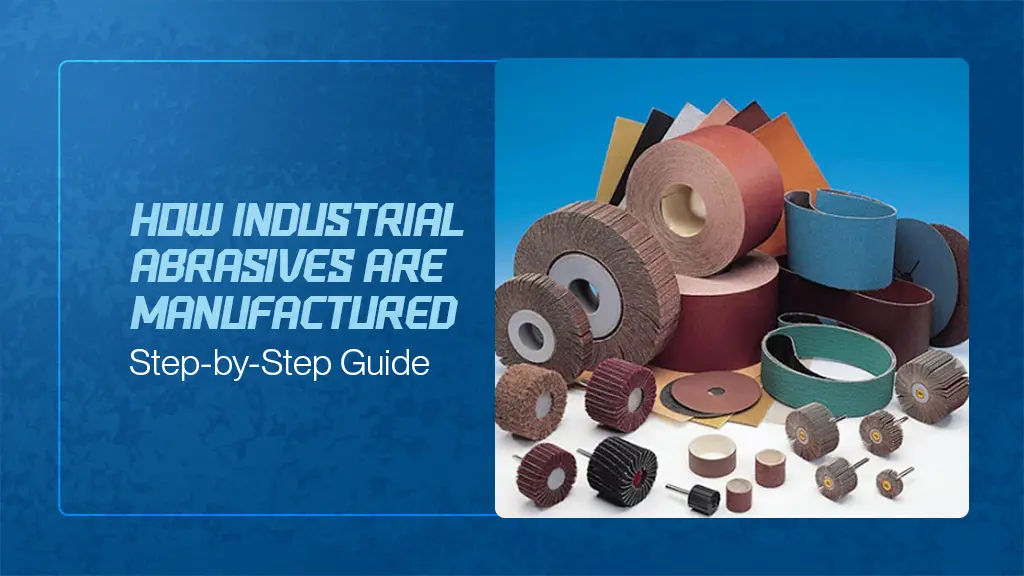
In industries like metal fabrication, construction, automotive, and manufacturing, abrasives play a critical role in shaping, cutting, grinding, and finishing materials. But for many B2B buyers, distributors, and procurement managers, one important question often goes unexplored: How are abrasives actually manufactured?
Understanding the abrasive manufacturing process is more than just technical knowledge—it directly impacts product quality, consistency, safety, and long-term cost efficiency. Whether you’re sourcing grinding discs in bulk or selecting flap discs for finishing applications, knowing how these products are made helps you make smarter purchasing decisions.
In this guide, we break down the step-by-step process of how abrasives are manufactured, covering both coated and bonded abrasives in a clear, practical, and business-focused way.
Types of Abrasives: A Quick Overview
Before diving into the manufacturing process, it’s important to understand the two main categories of abrasives:
Coated Abrasives
These are made by attaching abrasive grains to a flexible backing such as paper, cloth, or fiber.
Examples:
- Sandpaper
- Flap discs
- Sanding discs
- Abrasive belts
They are primarily used for finishing, polishing, and surface preparation.
Bonded Abrasives
These are formed by bonding abrasive grains together into solid shapes using various bonding agents.
Examples:
- Grinding wheels
- Cutting discs
- Mounted points
They are ideal for heavy grinding, cutting, and material removal.
Raw Materials Used in Abrasive Manufacturing
The quality of an abrasive product starts with its raw materials. High-performance abrasives rely on carefully selected inputs:
1. Abrasive Grains
These are the cutting elements of the product.
Common types include:
- Aluminum oxide
- Silicon carbide
- Zirconia alumina
- Ceramic grains
Each grain type is selected based on the application, hardness, and durability required.
2. Bonding Agents
Bonding materials hold the grains together or attach them to a backing.
Types include:
- Resin bonds
- Vitrified (ceramic) bonds
- Rubber bonds
3. Backing Materials (for Coated Abrasives)
- Paper backing
- Cloth backing
- Fiber backing
These materials determine flexibility, strength, and application suitability.
4. Additives and Fillers
Used to enhance:
- Heat resistance
- Strength
- Cutting efficiency
Step-by-Step Process for Bonded Abrasives
Bonded abrasives are manufactured through a highly controlled process to ensure strength and safety.
Step 1: Raw Material Selection
The process begins with selecting the right abrasive grains and bonding materials.
Key considerations include:
- Grain size (grit)
- Hardness
- Purity
For B2B buyers, this step is crucial because it directly affects product performance and lifespan.
Step 2: Mixing and Blending
The selected abrasive grains are mixed with bonding agents and additives.
This stage ensures:
- Uniform distribution of grains
- Consistent product quality
Advanced manufacturers use precision-controlled mixing systems to maintain consistency across bulk production.
Step 3: Molding and Shaping
The mixture is then pressed into the desired shape using molds.
Common forms include:
- Grinding wheels
- Cutting discs
- Segmented wheels
Hydraulic presses are typically used to achieve the required density and structure.
Step 4: Curing (Heat Treatment)
The molded products are subjected to controlled heat treatment.
This process:
- Hardens the bonding material
- Strengthens the structure
- Ensures durability under high-speed operation
Temperature and curing time must be precisely controlled to avoid defects.
Step 5: Finishing and Inspection
After curing, the products undergo finishing processes such as:
- Balancing
- Shaping
- Surface correction
They are then inspected for:
- Structural integrity
- Dimensional accuracy
- Performance standards
Step-by-Step Process for Coated Abrasives
The manufacturing process for coated abrasives is different, focusing on layering and adhesion.
Step 1: Backing Preparation
The process begins with selecting and preparing the backing material.
The choice depends on:
- Flexibility requirements
- Application type
- Strength needed
Step 2: Applying Base Adhesive (Make Coat)
A base adhesive layer, known as the make coat, is applied to the backing.
This layer acts as the foundation for holding abrasive grains.
Step 3: Grain Application
Abrasive grains are applied onto the adhesive layer.
Modern manufacturers use electrostatic coating, which aligns grains vertically for:
- Better cutting performance
- Improved efficiency
Step 4: Applying Top Adhesive (Size Coat)
A second adhesive layer is applied to lock the grains in place.
This ensures:
- Strong adhesion
- Longer product life
Step 5: Drying and Curing
The coated material is then dried and cured in controlled conditions.
This step enhances:
- Bond strength
- Heat resistance
Step 6: Cutting and Converting
Finally, the material is cut and converted into usable forms such as:
- Discs
- Belts
- Sheets
These are then packaged for distribution.
Quality Control in Abrasive Manufacturing
For B2B buyers, quality control is one of the most important aspects of abrasive production.
Reliable manufacturers perform strict testing, including:
- Strength testing to ensure durability
- RPM testing to verify safety at high speeds
- Consistency checks across batches
- Performance testing under real-world conditions
Poor quality control can lead to product failure, safety risks, and increased operational costs.
Key Factors That Affect Abrasive Performance
The effectiveness of an abrasive product depends on several manufacturing factors:
Grain Type and Size
Determines cutting speed and finish quality
Bonding Material
Affects strength and durability
Manufacturing Precision
Ensures consistency and reliability
Quality Standards
Guarantees safety and performance
Common Manufacturing Challenges
Even minor inconsistencies in manufacturing can impact product performance.
Common challenges include:
- Uneven grain distribution
- Weak bonding
- Improper curing
- Inconsistent quality across batches
This is why choosing a reliable manufacturer is essential for B2B buyers.
How Modern Technology Improves Abrasive Production
Today’s abrasive manufacturing industry has evolved with advanced technologies:
Automation
Ensures precision and consistency
Advanced Bonding Techniques
Improves strength and durability
High-Performance Materials
Enhances cutting efficiency
Strict Safety Standards
Reduces risk in industrial applications
These advancements allow manufacturers to produce abrasives that meet the demands of modern industries.
Why Manufacturing Quality Matters for B2B Buyers
For distributors, wholesalers, and industrial buyers, manufacturing quality directly impacts business outcomes.
1. Performance and Efficiency
High-quality abrasives deliver faster results and better finishes
2. Cost Savings
Durable products reduce replacement frequency
3. Safety and Reliability
Well-manufactured abrasives minimize risk
4. Brand Reputation
Consistent quality strengthens customer trust
Choosing the right supplier is not just about price—it’s about long-term value.
Conclusion
The process of how abrasives are manufactured is a combination of material science, engineering precision, and strict quality control.
From selecting high-quality grains to curing and finishing, every step plays a crucial role in determining the final product’s performance.
For B2B buyers, understanding this process helps in:
- Evaluating suppliers
- Ensuring product consistency
- Making cost-effective purchasing decisions
In a competitive market, knowledge of manufacturing quality can give your business a significant advantage.
Looking for High-Quality, Precisely Manufactured Abrasives?
If you’re sourcing abrasives in bulk, the manufacturing process behind the product matters just as much as the price.
Welldon specializes in producing high-performance coated and bonded abrasives designed for industrial applications. With advanced manufacturing processes and strict quality control, Welldon ensures consistent performance across every batch.
With Welldon, you benefit from:
- A complete range of coated and bonded abrasives
- Precision manufacturing for consistent quality
- Durable products built for industrial use
- Competitive pricing for bulk orders
- OEM and private label solutions for distributors
Whether you need grinding discs, cutting wheels, or flap discs, Welldon is your trusted partner for reliable abrasive solutions.
Contact Welldon today to discuss your bulk requirements and secure a dependable supply chain for your business.